

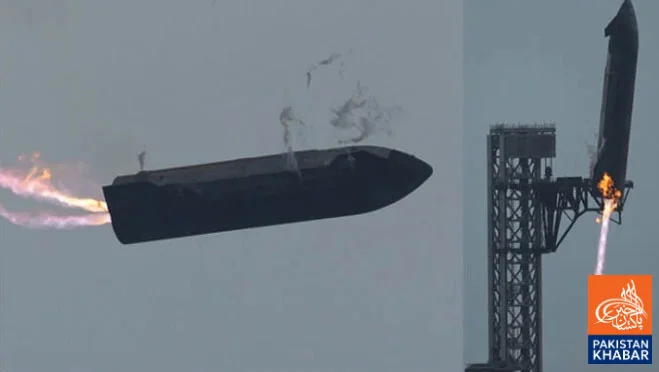
Texas (Web Desk): Elon Musk’s company SpaceX has achieved another major milestone in space exploration, successfully catching its Starship spacecraft in mid-air for the first time upon its return from space, using the giant mechanical arms of its launch tower.
According to the Associated Press, Starship successfully completed its return to Earth on Saturday. The spacecraft was caught by the mechanical arms at the same location from where it had taken off approximately 22 hours earlier.
This was the first time in history that the upper stage of a rocket had returned from orbit and been safely caught in this manner. However, SpaceX failed to achieve its goal of recovering both sections of the rocket because the first-stage booster exploded shortly after its launch from Texas on Friday.
Debris from the booster fell into the Gulf of Mexico, where a security perimeter was established to secure the area. Meanwhile, the stainless-steel Starship maintained its vertical position and successfully returned to the launch tower.
According to SpaceX officials, Starship’s safe return has paved the way for its reuse. The company is now preparing the spacecraft for future missions to the Moon and Mars. It is worth mentioning that SpaceX has previously caught its boosters successfully on three occasions.
The US space agency NASA has also welcomed the achievement. NASA is spending billions of dollars on Starship for its plans to land astronauts on the Moon and eventually establish a permanent base there. The agency is working to achieve these objectives by 2030, while Elon Musk also intends to develop a fleet of Starships to establish a human settlement on Mars.
Details of Starship’s Latest Flight
The world’s largest and most powerful rocket, measuring 407 feet or 124 metres in length, took off on Friday afternoon from SpaceX’s facility near the US-Mexico border.
During the initial phase of the flight, the upper spacecraft successfully separated from its booster. However, the booster subsequently developed a fault. After reaching orbit, Starship successfully deployed 26 advanced Starlink satellites.
The spacecraft completed 14 orbits around Earth at an altitude of approximately 165 miles, or 265 kilometres. During the flight, live footage of the spacecraft and views of Earth was broadcast through the Starlink system. In previous missions, Starship had completed only one or two orbits.
This was the 15th flight of a full-sized Starship since 2023 and its second mission to reach orbit. According to SpaceX, all major systems of the spacecraft, including its heat shield, appeared to function properly.
Regarding the booster, SpaceX’s Kate Tice said its engines shut down earlier than scheduled during its return towards Earth. The guidance system detected that the booster was heading in the wrong direction, after which the automated system began diverting it towards the ocean for destruction. Engineers are investigating the cause of the malfunction.
SpaceX hopes to begin Starship launches from NASA’s Kennedy Space Center in Florida within the next few months. This is also the site from which NASA’s upcoming Artemis mission is scheduled to launch. During that mission, the spacecraft will remain in Earth’s orbit rather than landing on the Moon, and will practise docking with a lunar spacecraft.
The four astronauts of Artemis III will attempt to connect their spacecraft capsule with Starship and Blue Origin’s spacecraft, Blue Moon. The two companies will take turns carrying out the responsibility of transporting astronauts to the lunar surface.
NASA aims to land humans on the Moon again in 2028 or earlier under Artemis IV. This would mark humanity’s return to the lunar surface more than half a century after the conclusion of the Apollo programme.