

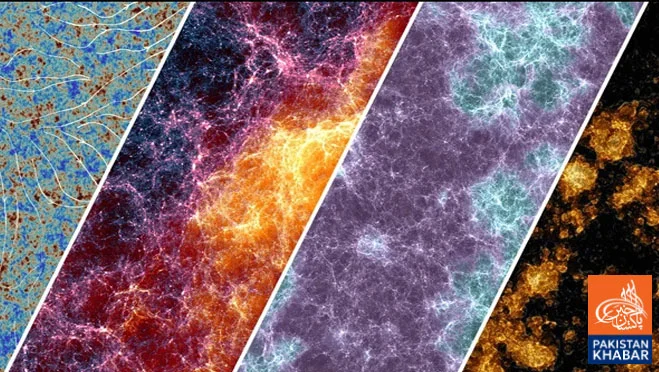
California (Web Desk): Scientists have developed a massive simulation called ‘LUMINA’ with the help of an advanced supercomputer, examining the evolutionary stages of the universe during its first 2 billion years. The research could help explain how the earliest stars, galaxies and black holes transformed the universe from darkness into light.
Developed by researchers from the Massachusetts Institute of Technology, Harvard University and other institutions, the simulation covers a cosmic region spanning approximately 1.6 billion light-years. The research has been published in the scientific journal Monthly Notices of the Royal Astronomical Society.
According to the study, approximately 380,000 years after the Big Bang, neutral hydrogen atoms began to form in the universe. At that time, stars did not yet exist, and most of the universe was immersed in darkness. This early period is scientifically known as the ‘Cosmic Dark Ages’.
Later, ultraviolet radiation emitted by the earliest stars and galaxies began stripping electrons from hydrogen atoms. This process, known as the reionization of hydrogen, gradually made the universe transparent to ultraviolet light.
The LUMINA simulation also represents the process of helium reionization alongside hydrogen reionization. According to the research, the earliest stars and galaxies played a fundamental role in ionizing hydrogen, while intense radiation emitted by massive black holes was a major cause of helium ionization.
The simulation examines the movement and interactions of dark matter, gas, stars and particles of light. It incorporates approximately half a trillion individual elements. It is around 30 times more detailed than the previous model, while the volume of the cosmic region under study is approximately 100 times larger than that covered by earlier large-scale simulations.
The project was completed with the assistance of the ‘Frontier’ supercomputer at Oak Ridge National Laboratory in the United States. During the key computational phase, the combined processing power of more than 100,000 central processing units and approximately 15,000 graphics processing units was used.
Through LUMINA, researchers can observe the stages ranging from the formation of early galaxies to the spread of radiation emitted by them. The simulation demonstrates how gas and dark matter accumulate in specific regions, how stars and galaxies form there, and how the radiation they emit brings changes to the surrounding hydrogen.
According to the research, a key feature of this simulation is that it enables scientists to study both vast regions of the universe and individual galaxies in considerable detail. Researchers now plan to compare its findings with observations obtained through future telescopes to further test scientific theories about the early universe.
Scientists from the Massachusetts Institute of Technology, Harvard University and other international institutions participated in the research, while the project received partial financial support from NASA and the National Science Foundation.