

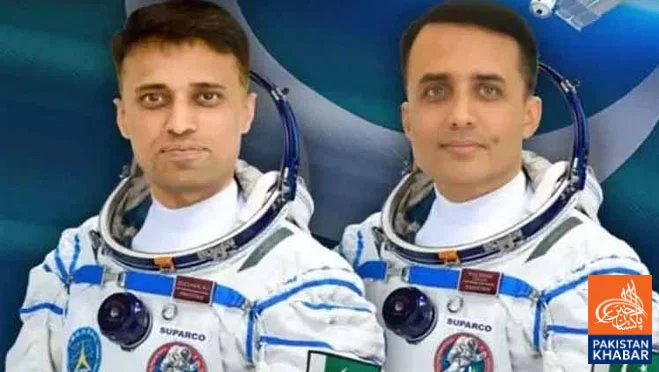
Islamabad (Web Desk) — Under space cooperation between Pakistan and China, the time is drawing closer for a Pakistani citizen to travel to China’s Tiangong Space Station, with the training of two Pakistani pilots entering its final stages.
Pakistani pilots Zeeshan Ali and Khurram Dawood have been undergoing rigorous and comprehensive training for several months at the China Astronaut Research and Training Center in Beijing, including training in the Chinese language.
The space mission is part of the space cooperation agreement reached between the two countries in 2019. According to Amir Gilani, head of human spaceflight cooperation at SUPARCO, a final decision on the name of the astronaut is expected by the middle or end of October.
The selected Pakistani pilot will depart directly from China for the space mission and join the mission without returning to Pakistan. After returning to Earth, the pilot will complete the recovery process before returning home. This will be the first time in Pakistan’s history that a citizen of the country will travel into space.
According to SUPARCO Director of Artificial Intelligence Uzair Ansari, 42 finalists were initially selected from a large group of pilots and scientists, who also underwent medical examinations and psychological tests.
He said scientists generally have relatively less ability to withstand high-speed flight and severe physical stress, which is why fighter pilots were selected.
The Pakistani astronaut traveling into space will perform duties as a payload specialist, whose primary responsibility will be to conduct Pakistan’s scientific experiments rather than operate the spacecraft.
Chinese institutions have selected four biotechnology experiments from more than 300 proposals received from universities in Karachi, Lahore and Islamabad. These experiments will help address challenges related to food security and climate change.
Uzair Ansari said this is an extremely rare, once-in-a-lifetime opportunity for Pakistani scientists, providing a chance to test Pakistani technology at the global level.
Despite Pakistan not having its own spacecraft or rocket, the space partnership between the two countries is extensive, and the mission is fully linked to Chinese technology, language and guidance.
Space cooperation between Pakistan and China is not limited to the space station. A Pakistani robotic rover is also planned to be sent to the Moon through China’s Chang’e-8 lunar mission around 2028.
The rover, which will travel to the lunar surface, will use autonomous systems and artificial intelligence to identify obstacles along its path and determine its route as it moves forward.