

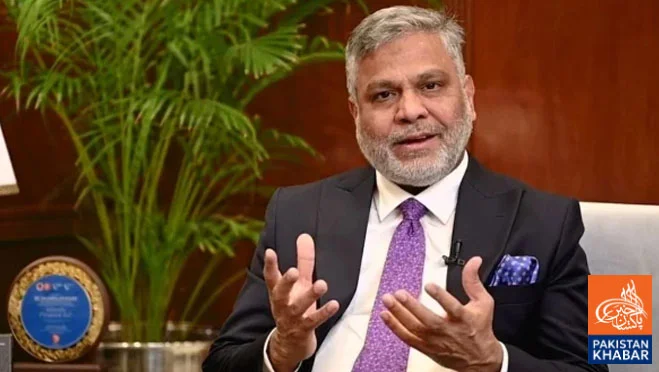
Karachi (Commerce Desk): State Bank of Pakistan Deputy Governor Saleemullah has said that Pakistan is expected to receive $45 billion in remittances by the end of the current fiscal year.
Addressing the “Reset 2.0: Retail Banking and Small Business Conference”, organised jointly by Greenpak International and the Pakistan Banks Association at a private hotel in Karachi, he said that due to the lack of suitable investment products for overseas Pakistanis, remittance funds generally flow into real estate and other sectors. He said banks needed to pay attention to this area as well. According to him, several technology platforms offer promising opportunities in this regard.
The State Bank deputy governor said Pakistan’s banking sector had made significant progress over the past five years, but several challenges remained unresolved. He stressed that the banking sector would have to play its role in increasing the country’s real gross domestic product (GDP), as the growth rate in some sectors, including agriculture, was still failing to exceed 2.5 per cent.
He said Pakistan had achieved economic stability over the past four years, but this had come at the cost of low economic growth and unemployment. During this period, the average GDP growth rate remained at just 2.1 per cent. According to him, economic stability had laid the foundation for development, and a strategy was now needed to accelerate economic activity. Promoting small and medium-sized enterprises (SMEs) during the remaining eight months of the current fiscal year was also among the priorities.
Saleemullah said that 2.9 million small and medium-sized businesses in Pakistan did not have access to bank financing. He added that greater attention to agriculture and small businesses would automatically create opportunities for new banking products. Any business could grow only when the purchasing power of its customers and overall commercial activity increased.
He urged banks to earn profits but said that instead of increasing their income solely through customers’ deposits, they should introduce products that offered genuine benefits to consumers.
Addressing the conference, Pakistan Stock Exchange Chief Executive Officer Farrukh Sabzwari said the younger generation should be encouraged, rather than discouraged, from investing in the stock market. He urged parents to allow young people to benefit from investment opportunities.
According to him, an average of 25,000 new accounts were being opened at the Pakistan Stock Exchange every month, compared with approximately 5,000 per month last year. He said parents of the younger generation had suffered losses during the financial crises of 1998 and 2008, which had made them advise their children to remain cautious about investments.
Farrukh Sabzwari said a Sahulat Account could be opened at the Pakistan Stock Exchange in just seven minutes, without complicated documentation requirements. Regular accounts, however, faced issues relating to anti-money laundering regulations and customer identification requirements. He said work was under way with the Securities and Exchange Commission of Pakistan and the State Bank to resolve these issues.
Bank Alfalah President and Chief Executive Officer Atif Bajwa said Pakistan’s banking sector had been considerably behind a decade ago, but current figures reflected progress, while the country’s GDP had also improved.
Criticising the growing profitability of the banking sector, he said banks introduced numerous products, but often focused more on their financial targets and profits than on customers’ needs. According to him, current accounts were particularly profitable for banks under prevailing circumstances. However, advising customers to open such accounts could benefit banks rather than the account holders.
Atif Bajwa said several matters required a detailed review, including the difference in profit margins between conventional and Islamic banks.
Federal Adviser on Finance for Special Initiatives Adnan Pasha said providing small businesses and farmers with loans on easy terms was essential for sustainable economic growth. He said that when people could not obtain loans through the formal banking system, they turned to informal sources, making sustainable economic development difficult.
He said that under the government’s Zarkhaiz Programme, every farmer had been provided with a bank account. The government was helping banks reduce risks while also creating new business opportunities for them. Discussions were also under way with the Small and Medium Enterprises Development Authority (SMEDA) to meet the financing needs of small businesses through cooperation between banks and relevant institutions.
Adnan Pasha said the Zarkhaiz 2.0 Programme would be launched next year, under which banks would be required to share lending risks and focus on increasing production instead of merely introducing financial products.
He further said the prime minister reviewed the Prime Minister’s Access to Credit Programme every month, adding that continuity in policies could help improve the availability of loans. He stressed that, with the support of banks, agricultural financing needed to be increased to Rs2,000 billion.