

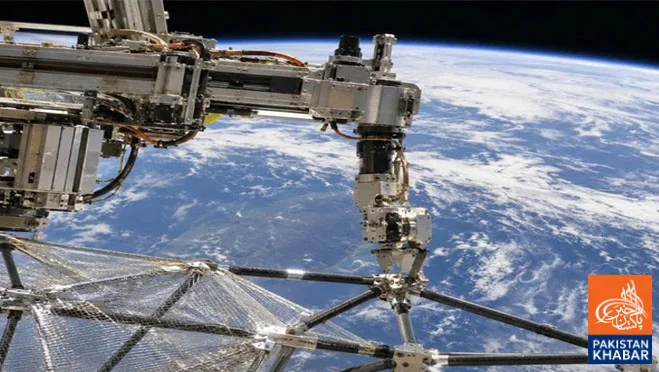
CALIFORNIA (Web Desk) – A robot named 'ASTRA', developed by experts at the US research institution California Institute of Technology (Caltech), has successfully assembled and built a section of a reflector antenna in space without any assistance from astronauts.
Scientific experts are calling this successful experiment an important milestone toward constructing large structures inside space in the future, which will make it possible to overcome the longstanding problem of limited cargo capacity in rockets.
According to the report, funded by the US defense research agency 'DARPA', this robot formed a 1.4-meter-long section of a reflector antenna using composite fiber tubes and aluminum joints. A prominent feature of this project is that the construction components were transported to space in an extremely compact form, where the robot automatically assembled them into the required structure.
Researchers say this advanced technology will prove extremely helpful in the future construction of giant space telescopes, advanced communication systems, and large space-based solar power projects.
This project is part of the 'NOM4D' program, which was launched in 2022. Under the program, another experiment is also expected at the end of this year, in which advanced techniques of space manufacturing will be tested on the International Space Station (ISS). According to experts, if these experiments continue to succeed, large space structures in the future will be built directly in space via robots rather than being sent pre-built from Earth.