

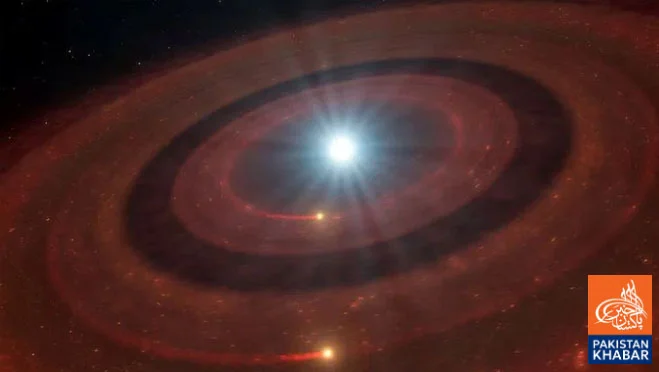
Houston (Web Desk): Astronomers have discovered an unusual white dwarf star in the Milky Way galaxy, surrounded by scattered planetary material orbiting in the form of two separate rings. According to scientists, this discovery could help improve understanding of the Sun's eventual fate and the possible future condition of the Solar System.
According to the research, the white dwarf star, named J13281450, is located approximately 1,600 light-years from Earth in the constellation Virgo. The two-ring structure of debris surrounding it is unusual, as only a single ring had previously been observed around such stars.
Scientists believe that two planets or small rocky bodies are part of the debris rings orbiting this star and have managed to survive despite the catastrophic changes that took place in the star.
These observations were made using the European Southern Observatory's Extremely Large Telescope, located in Chile. Before this discovery, astronomers had identified planetary debris around 21 white dwarf stars, but only a single ring or disc had been observed around each of them.
According to the study's lead author, astronomer Felipe Lagos Veliches of the University of Chile, this discovery indicates that the remains of planetary systems following the death of their stars can become far more complex than previously expected.
Scientists say that billions of years from now, when the Sun runs out of fuel, it will expand and transform into a red giant star. Subsequently, its outer layers will disperse into space, while its remaining core will become an extremely dense white dwarf star.
During this process, some planets in the Solar System may be completely destroyed, while others could potentially survive.
The discovered white dwarf star has a mass approximately 47 percent that of the Sun. However, all its material is compressed into an extremely small volume with a diameter roughly equal to that of Earth.
This important research has been published in the scientific journal Nature Astronomy.