

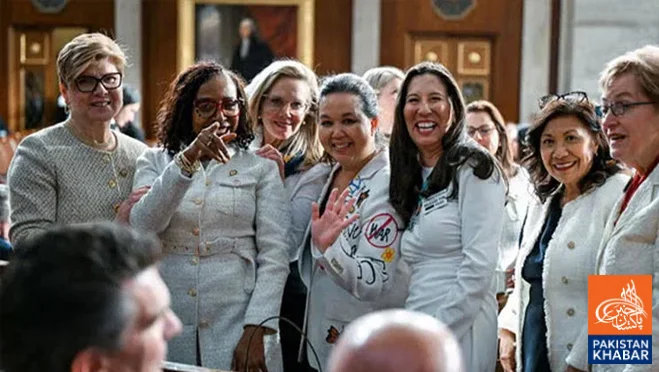
Washington (Monitoring Desk) – According to US election results, more than 100 Democratic women are set to become members of the House of Representatives simultaneously for the first time, marking a significant milestone in women's political representation in American politics.
New Mexico Congresswoman and head of the Democratic Women's Caucus, Teresa Leger Fernandez, said women had made history through the power of their votes and succeeded in sending more than 100 Democratic women to the House of Representatives.
According to her, women bore the greatest impact of the Trump administration's policies and the Republican Party's hardline political agenda. However, in the recent elections, they expressed their dissatisfaction with government policies through their votes.
The electoral wing of the Democratic Women's Caucus had set a target of electing at least 100 women from the very beginning of the election campaign. According to Florida Congresswoman and founding member of the organisation Lois Frankel, having 100 women elected to the House of Representatives was a major symbolic achievement, although the party wanted to elect even more women.
Behind this achievement are decades of political struggle, efforts to prepare female candidates and initiatives to raise financial resources for election campaigns. Several organisations, including EMILY's List, provided support to Democratic women to help them advance in the electoral arena and make their campaigns more effective.
EMILY's List President Jessica Mackler said this achievement proved that women were fully capable of running successful election campaigns when provided with adequate opportunities and resources.
In the recent elections, female candidates won 18 of the 40 seats secured by Democrats. Voters' dissatisfaction over inflation, rising prices of everyday goods and perceptions of corruption also influenced the election results.
Several female candidates achieved victories by defeating incumbent members of their own party. These included Jasmine Clark of Georgia, Melat Kiros of Colorado and Daria Liza Avila Chevalier of New York.
Jasmine Clark will become the first Black female scientist with a PhD in the US Congress, while Melat Kiros will be the first Black woman to represent Colorado and the first female member of Congress belonging to Generation Z.
It is worth mentioning that women make up approximately half of the total US population, yet their representation in Congress remains limited to just 28 percent. In 1917, Jeannette Rankin became the first woman elected to the US Congress, after which women continued a long struggle for political representation and equal rights.
According to political observers, the success of more than 100 Democratic women reflects the growing influence of women in American politics and could create further opportunities for their participation in the country's highest political leadership in the future.