

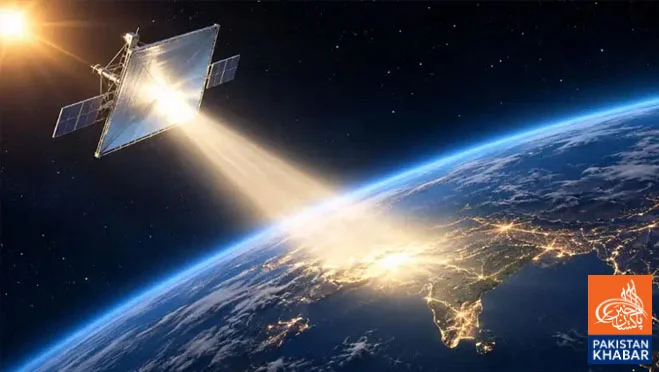
California (Web Desk): An American space technology company has developed a unique plan to provide sunlight to Earth even during nighttime. Under the project, large mirrors will be installed in space to reflect sunlight towards specific locations on Earth.
The California-based company Reflect Orbital is working on this project. The company plans to launch satellites equipped with large mirrors that will reflect sunlight and illuminate selected locations on Earth at night.
For this purpose, the company has also signed an agreement with rocket manufacturer Skyroot Aerospace to launch two rockets.
According to the company, this advanced technology could help solar energy projects continue generating electricity even after sunset. It could also be used to provide lighting in areas affected by natural disasters and support emergency relief operations.
Under the project, large mirrors measuring approximately 18 by 18 metres will be installed in low Earth orbit. Their positions can be adjusted to reflect sunlight towards targeted locations. The initial experiment aims to illuminate an area approximately five kilometres wide.
According to the company, the first test of the project is expected in the second quarter of 2027, using a satellite named Earendel-1. The company's long-term goal is to establish a network of 50,000 satellites in space by 2035.
Reflect Orbital says that, during the initial phase, the light reflected by these satellites will be equivalent to moonlight. However, increasing the number of satellites in the future could enhance the intensity and duration of illumination. The company intends to offer this service to users through a mobile application, allowing people to select their desired locations and request illumination.
On the other hand, the project has raised concerns among astronomers and environmental experts. They argue that installing large numbers of mirrors in space could negatively affect natural nighttime darkness, the environment and astronomical observations.
A study published in the scientific journal The Astrophysical Journal Letters in August 2025 also examined the potential harmful effects of this technology. According to the research, light reflected from space could strike gases, dust and other particles in the atmosphere and scatter in different directions. As a result, the light may not remain limited to the targeted location and could also affect surrounding areas.
According to computer models presented in the study, even if the mirrors are positioned approximately 14 kilometres away from the intended location, the light reaching Earth could be brighter than that of a full moon, potentially exposing nearby communities to unwanted illumination.
However, these findings are based on computer models and scientific estimates. Therefore, practical experiments are considered necessary to determine the actual effects of the technology.
The company received approval for the project from the relevant US regulatory authority in July. However, astronomers and environmental organisations have expressed reservations and have also called on the US Federal Communications Commission to withdraw its approval.
According to experts, the success of this project will depend not only on maintaining the correct positions of the satellites but also on assessing their potential effects on Earth's natural environment, human life and the night sky.