
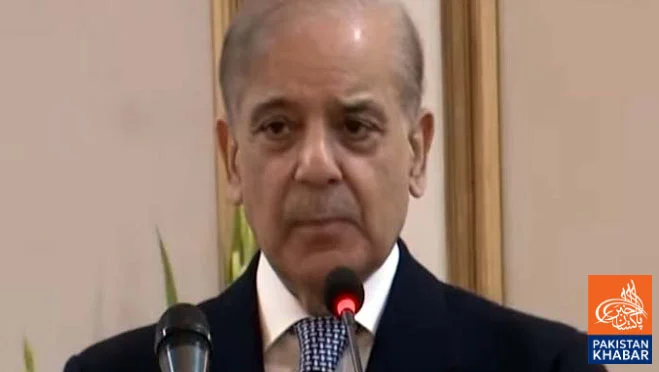
Islamabad (Pakistan News): Prime Minister Shehbaz Sharif has said that governor's rule and an emergency were imposed in Khyber Pakhtunkhwa due to unavoidable circumstances, adding that the province could have suffered further losses if the decision had not been taken in time.
Addressing the parliamentary party of the Pakistan Muslim League-Nawaz (PML-N) in Khyber Pakhtunkhwa, the prime minister said the province was beautiful and its people were courageous, brave and dignified. He said the PML-N had played an important role in promoting democratic traditions in the province. After the 2013 elections, Nawaz Sharif had given the majority party an opportunity to form the government.
Shehbaz Sharif said the party that had been in power in the province for the past 13 years had made tall claims, but questioned how many universities and hospitals had been built during that period. From Peshawar to Kohistan, Hazara and the southern districts, he said, problems had remained neglected.
According to the prime minister, the country had faced the politics of long marches and sit-ins over the past two and a half years. The 2014 sit-in had led to the postponement of the Chinese president's visit to Pakistan. However, during President Xi Jinping's visit in 2015, important agreements were signed.
He said efforts had been made to resolve matters through negotiations before governor's rule and the emergency were imposed in Khyber Pakhtunkhwa. A committee comprising members of the Pakistan Peoples Party and the PML-N held talks for 48 hours, after which approval of the agreed draft was awaited, but it was not granted. The prime minister said a decision had become necessary to protect the people, the country, the economy and society.
Shehbaz Sharif said terrorists had been brought back from Afghanistan and resettled in 2019 and 2020, allowing terrorism to resurface and causing heavy losses to the country. He also referred to his call for a joint struggle against terrorism, as had been undertaken in the past.
The prime minister further said that military and political leadership had worked together to stabilise the national economy. Due to international circumstances and the Gulf war, energy prices had risen unusually sharply. However, the government had launched a fuel subsidy scheme to provide relief to the public, benefiting 13 million people so far.
According to him, Rs75 billion had been allocated for public relief, and providing assistance to the poorer sections of society remained a key government priority. He added that all possible measures were also being taken to protect the national economy from instability.