

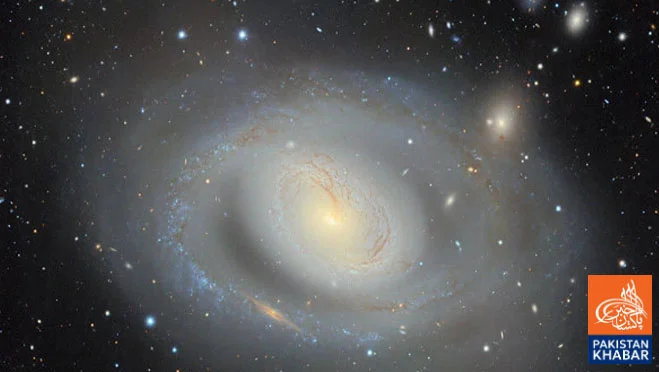
New York (Monitoring Desk): Astronomers have released the largest two-dimensional color map of the universe to date, containing data on approximately 4 billion stars, galaxies and other celestial objects.
The extraordinary map was created by the DESI Legacy Imaging Surveys team and contains 5.6 trillion pixels. Its data is available to the general public, astronomers and citizen scientists, and can be viewed online through the Legacy Survey Sky Viewer.
According to scientists, the new image will make it easier to detect rare phenomena in space, including gravitational lensing and short-lived events, particularly supernovae.
The map will also help experts investigate two major mysteries of the universe: dark matter and dark energy. Dark matter is believed to account for most of the mass of matter in the universe, while dark energy plays a fundamental role in the universe’s accelerating expansion.
The new map is based on previous observational data from the DESI Legacy Imaging Surveys, which has already gained significant importance in astronomical research. So far, more than 1,800 scientific papers have used or cited this data.
According to David Schlegel, co-leader of the Legacy Surveys and a scientist at the US Lawrence Berkeley National Laboratory, this information has become an important resource for astronomical research, and experts often examine celestial objects through the Legacy Imaging Viewer before beginning research on them.
Experts say the new mapping has opened new avenues for research into the large-scale structure of the universe, billions of celestial objects and its fundamental mysteries.