

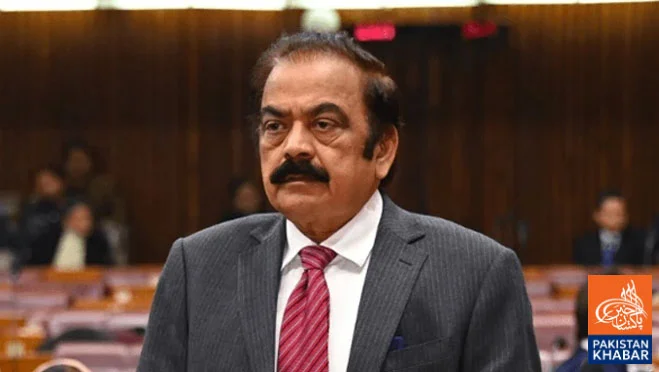
ISLAMABAD (Pakistan News): Prime Minister’s Adviser on Political Affairs Rana Sanaullah has said that the possibility of negotiations with Pakistan Tehreek-e-Insaf (PTI) could be considered if the party is willing to play a positive role while remaining within the constitutional and legal framework.
According to a private television channel, Rana Sanaullah said that further progress on the matter would be possible if PTI agreed to fulfil its constitutional and legal responsibilities. He added that the opposition’s current approach was proving detrimental to the party itself.
The prime minister’s adviser said that during Imran Khan’s tenure as prime minister, he had not even contacted the opposition leader by telephone. In contrast, Prime Minister Shehbaz Sharif shakes hands and holds conversations with the opposition leader whenever he comes to the National Assembly.
Expressing regret over the detention of Imran Khan’s sisters, Rana Sanaullah said the government was also saddened by the situation. However, he added that everyone knew what Imran Khan’s sisters had been saying about the long march.
He claimed that Imran Khan’s sisters had made statements about storming the Governor’s House, making their detention necessary to maintain control of the situation.
Referring to PTI’s social media activity, Rana Sanaullah said everyone was aware of the nature of the discussions taking place on social media platforms associated with the party. He further said that if PTI had been willing to play its role through constitutional and legal means, there would have been no need for an interim arrangement. Nevertheless, he added, the matter could still be considered.
Speaking about terrorism, the prime minister’s adviser warned that if the menace was not eliminated promptly and the entire nation did not unite against it, the country’s very existence could be threatened. He stressed that the federal and provincial governments should adopt a unified policy to tackle terrorism.
Commenting on India, Rana Sanaullah said the country was no longer in a position to wage a conventional war against Pakistan and had established its bases in Afghanistan. He alleged that India was using financial resources to sponsor terrorism in Pakistan, adding that the wider region viewed Pakistan as a country providing security.