

Houston (Web Desk) NASA’s latest space telescope, the Roman Space Telescope, has been launched into space.
The telescope has embarked on a mission to search for planets orbiting other stars, uncover the secrets of dark energy hidden in the universe, and observe a much larger portion of the cosmos than ever before.
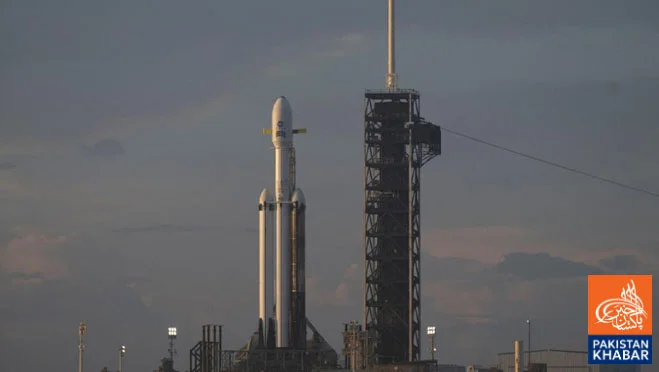
SpaceX launched the $4.3 billion Roman Space Telescope aboard a Falcon Heavy rocket. Roman is heading toward an observation point approximately 1.6 million kilometres away, where NASA’s other major and expensive space telescope, the James Webb Space Telescope, is also located.
About the size of a bus, the telescope is named after Nancy Grace Roman, NASA’s first chief astronomer. It will take more than three months to reach its destination, after which it will conduct the widest-ever observation of the hidden parts of the universe from space and reveal facts that are difficult even to imagine.
NASA Science Mission Directorate Associate Administrator Nicky Fox said the telescope will discover thousands of supernovae, tens of thousands of planets, billions of galaxies and tens of billions of stars. Its wide field of view will enable observations that were previously impossible.
Minutes after the rocket blasted off, its two reusable side boosters descended and landed back at Cape Canaveral with a loud roar in a spectacular scene. Shortly afterward, the telescope also successfully separated from the rocket’s upper stage, prompting applause and celebration among ground controllers.
Roman’s field of view is more than 100 times wider than that of NASA’s Hubble Space Telescope. Despite spending 36 years in space, Hubble continues to send spectacular images of the universe.
The James Webb Space Telescope joined this mission a few years ago. Its field of view is relatively limited, but it can observe celestial objects in extraordinary detail, including some that are almost as old as the universe itself, dating back to around the time of the Big Bang.
These three space telescopes, together with the European Space Agency’s Euclid mission and the National Science Foundation’s Vera C. Rubin Observatory in Chile, will work to uncover some of the universe’s greatest mysteries.
Among the countless galaxies awaiting discovery are stars with planets orbiting them. When Roman detects these new worlds, the more powerful and sensitive James Webb telescope will examine them in greater detail to gather additional information.
Senior mission scientist Julie McEnery said one day before the launch that Roman’s wide reach would enable scientists to search for strange, rare and unusual objects.
Astronomers expect Roman to provide important information about dark matter and dark energy, which make up most of the universe but have remained hidden from direct observation. The catalogue of galaxies produced by Roman will help scientists understand how rapidly the universe is expanding under the influence of these mysterious and invisible forces.
Roman’s greatest strength is its speed. It would take Hubble a century to complete a month-long observation of the Milky Way, while Roman will be able to survey the bulge at the very centre of the galaxy extremely quickly, enabling the deepest-ever observation of the centre of our galaxy.