

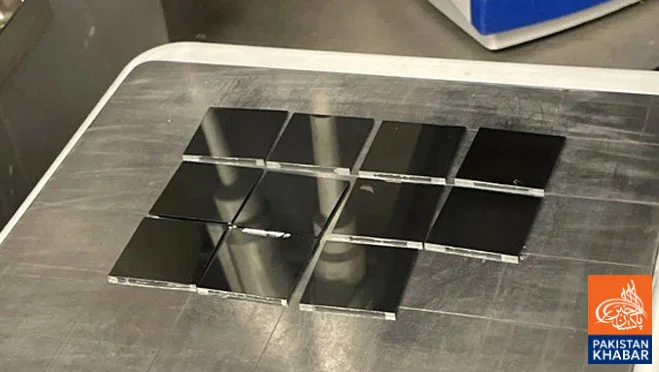
CALIFORNIA (Web Desk): A team of scientists co-led by researchers from the University of California, San Diego, has developed a new method to make perovskite solar cells more efficient and durable. The technology is considered a promising alternative for harnessing solar energy.
According to the research, scientists used a technique that temporarily creates a liquid phase during the crystallization process. This approach enabled them to produce larger, more uniform perovskite crystals with fewer defects.
Solar cells and light-emitting diodes (LEDs) made from this material achieved efficiencies of approximately 24 to 26 percent, marking a significant advancement for perovskite-based devices.
During experiments, the solar cells were operated continuously under simulated sunlight for eight weeks. Even after this period, they retained most of their initial performance.
Perovskite is a material that can be used to manufacture efficient solar cells at a relatively low cost. Unlike conventional silicon solar cells, it can be prepared in a solution and applied to surfaces as thin films. This manufacturing approach could simplify solar cell production and reduce energy consumption.
The scientists’ findings have been published in the scientific journal Science.