

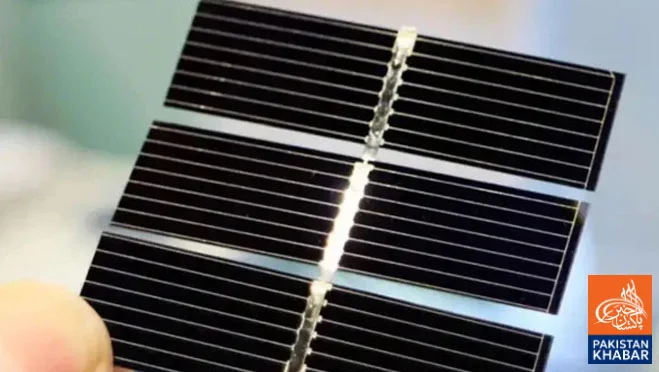
California (Web Desk): Chinese scientists have developed a new technique to make organic solar cells more efficient and stable, potentially helping bring the technology into widespread commercial use.
The breakthrough was achieved by a research team led by Professor Ji Ze Yi at the Ningbo Institute of Materials Technology and Engineering, part of the Chinese Academy of Sciences.
Unlike silicon-based solar cells, organic solar cells convert sunlight into electricity using carbon-based organic materials. They can be manufactured at relatively low cost and are lightweight, flexible and suitable for production over large areas.
However, prolonged exposure to light and heat can cause certain molecular layers within these cells to detach from their surfaces, affecting their long-term performance.
To address this problem, the researchers used a vacuum-deposited indium chloride interlayer to strengthen the connection between the electrode and the hole-transport layer.
According to the study, the technique creates a robust molecular network that holds the interfacial layers uniformly in place on the surface, improving their stability.
The scientists say the development could help advance the production of more efficient and durable organic solar cells.
The research was published on October 21 in the scientific journal Joule, presenting a new approach to bringing organic solar technology into widespread commercial use.