

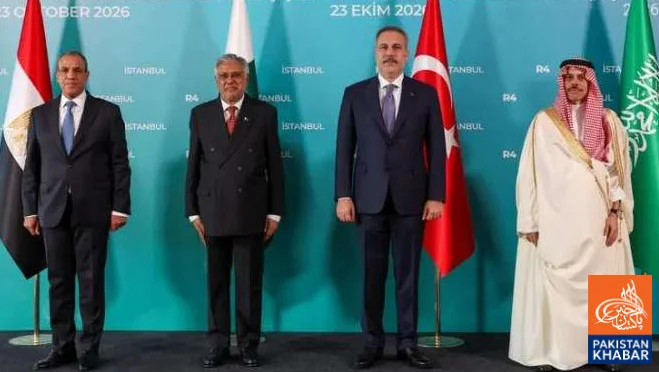
Istanbul (Monitoring Desk): Pakistan, Saudi Arabia, Turkey, and Egypt have strongly condemned attacks by Yemen's Houthi militia on Saudi Arabia and called for them to stop immediately and unconditionally. The four countries reaffirmed their full support for Saudi Arabia's sovereignty, territorial integrity, and security, while urging efforts to ease tensions in the Middle East and resolve conflicts through diplomacy.
A key meeting of the foreign ministers of the regional four-nation group, known as R4, was held in Istanbul, Turkey, on Friday, October 23. The meeting was attended by Pakistan's Deputy Prime Minister and Foreign Minister Ishaq Dar, Saudi Foreign Minister Prince Faisal bin Farhan, Turkish Foreign Minister Hakan Fidan, and Egyptian Foreign Minister Badr Abdelatty.
According to Pakistan's Foreign Office, the meeting included a detailed review of the latest situation in the Middle East, threats to regional security, and ongoing conflicts. The foreign ministers condemned Houthi attacks on Saudi Arabia and reaffirmed their support for protecting the kingdom's sovereignty and territorial integrity.
Call for an Immediate and Unconditional End to Houthi Attacks
In a joint statement issued on October 11, the R4 group had also described Houthi attacks on Saudi Arabia as a clear violation of international law.
The statement strongly condemned attacks on civilian facilities, including Riyadh's King Khalid International Airport, noting that these actions had resulted in civilian deaths and injuries and caused damage to infrastructure.
The four countries described the attacks as violations of Saudi Arabia's sovereignty and territorial integrity, stating that such actions were unacceptable under any circumstances. They held the Houthi militia responsible for the attacks and their regional and international consequences, and called for an immediate and unconditional ceasefire.
Pakistan Reaffirms Support for Saudi Arabia's Security
During the Istanbul meeting, Ishaq Dar briefed participants on Pakistan's diplomatic efforts to reduce regional tensions and promote peace. According to the Foreign Office, the four countries agreed to strengthen mutual contacts and continue joint efforts to promote regional peace and stability.
On the sidelines of the meeting, Ishaq Dar also met Turkish Foreign Minister Hakan Fidan. Both leaders condemned Houthi attacks on Saudi Arabia and expressed their commitment to continued close cooperation on regional issues.
The foreign ministers of Pakistan and Turkey also stressed the importance of enhancing coordination on shared regional security matters, including the Makkah Defence Agreement.
Concerns Over the Security of Key Maritime Routes
According to Egyptian media, the four foreign ministers stressed the need for political and diplomatic solutions to regional conflicts, warning that any further escalation of military tensions could have serious economic and security consequences.
The meeting also highlighted the importance of ensuring the security of key international maritime routes, including the Strait of Hormuz and the Bab al-Mandab Strait, and maintaining freedom of navigation. The ministers described these routes as critically important to global trade and supply chains.
Talks Also Held With European Foreign Ministers
Following the R4 meeting, the foreign ministers of Pakistan, Saudi Arabia, Turkey, and Egypt also held talks with their counterparts from France, Germany, the United Kingdom, and Italy.
According to an official statement from Pakistan, the discussions focused on the situation in the Gulf region, its economic and social consequences, and ways to increase diplomatic engagement to resolve regional conflicts.
Ishaq Dar briefed the participants on Pakistan's diplomatic efforts to ease tensions, prevent a resumption of military operations, and promote regional peace. The foreign ministers attending the meeting agreed to continue such consultations.
The joint position of the four countries comes at a time when the conflict in Yemen and Houthi attacks on Saudi Arabia are creating new security challenges in the Middle East, while Pakistan and other regional countries are calling for coordinated diplomatic efforts to reduce tensions.