

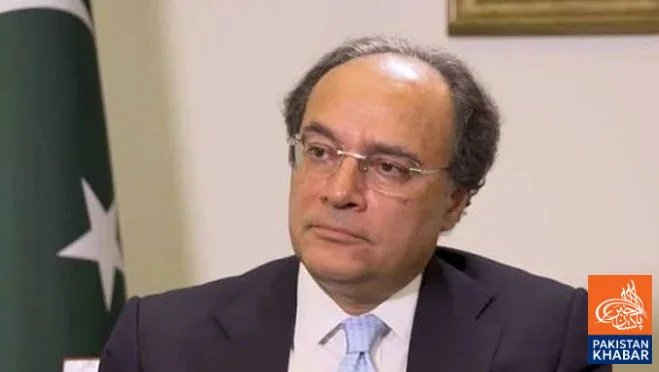
Islamabad (Business Desk): Federal Finance Minister Muhammad Aurangzeb has said Pakistan will not rush to borrow from international capital markets during the current fiscal year, as the government pursues a strategy to ease pressure from external debt repayments and expand access to global financial markets.
Speaking in an interview with Bloomberg, Aurangzeb said maintaining inflation, foreign exchange reserves, and interest rates at appropriate levels was essential for economic stability. Pakistan issued $750 million worth of bonds through a private placement in April this year.
According to the finance minister, Pakistan has successfully accessed China’s Panda bond market through a credit facility. China is among the world’s largest and deepest bond markets, making the issuance of bonds there an important development for Pakistan.
He said Pakistan had issued $3 billion worth of Eurobonds approximately three weeks ago, attracting investor demand twice the amount offered. Investors from Asia, the Middle East, Europe, and the United States participated in the issuance, enabling Pakistan to regain access to international capital markets after a four-year gap.
Aurangzeb said relevant institutions had also been assigned responsibilities for issuing Islamic sukuk as part of the government’s medium-term strategy. Investors were also showing interest in rupee-denominated bonds with payments in dollars.
He added that steps would be taken to issue additional bonds under Pakistan’s $1 billion Panda bond programme. Pakistan has so far issued $250 million worth of Panda bonds, while the possibility of converting Eurobonds into digital tokens is also being examined.
The finance minister clarified that the timing, size, pricing, and maturity of bond issuances would be determined in light of global market conditions. He said Pakistan did not need to borrow from international markets to meet its external financing requirements during the current fiscal year. However, the government wanted to convert some short-term external loans into long-term debt. Pakistan’s objective is to maintain its overall external debt level while ensuring its sustainable management.
He revealed that Pakistan’s sovereign credit rating had been upgraded three times since April last year, placing the country in the B category. If the current progress continues, Pakistan expects to achieve a B+ rating by early next year, with entry into the BB category remaining a longer-term goal.
According to Aurangzeb, the government is increasingly focusing on promoting trade and investment rather than relying on aid. Negotiations with the United States concerning tariffs and a framework agreement are ongoing, while engagement with US officials is progressing positively. He expressed hope that these discussions would help boost bilateral trade and investment.
The finance minister said the stability of the Pakistani rupee reflected an overall improvement in the economy. The country’s foreign exchange reserves now cover approximately three months of imports, compared with only two weeks of imports three years ago.
He noted that Pakistan’s economic growth rate had fallen to 0.3% three years ago before rising to 2.6% the following year. Growth reached 3.7% in the last fiscal year, and the government expects stronger performance in the current fiscal year.
Aurangzeb further said the government was continuously monitoring the impact of the ongoing conflict in the Middle East on inflation and economic growth, noting that the conflict had also affected Pakistan’s economic growth during the previous fiscal year.