

Nairobi (Web Desk) Access to healthcare is a major challenge in Africa. Around one-third of the continent’s population lives in areas where it can take more than two hours to reach a healthcare facility. In addition, the lack of electricity at many medical centres makes it difficult to operate essential medical equipment and provide certain healthcare services.
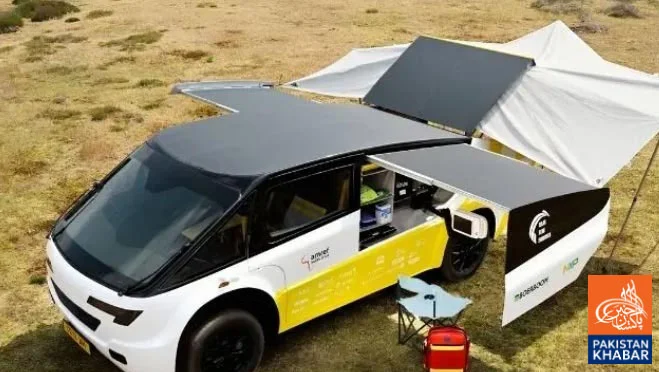
To address this problem, students from the Netherlands have developed a unique solar-powered ambulance called “Stella Joule.” The vehicle is equipped with various medical devices, including an X-ray machine, ultrasound equipment and a refrigerator for storing vaccines.
According to CNN, solar panels have been installed on the roof of the vehicle, generating energy even while it is travelling. When the vehicle is stationary, additional solar panels can be pulled out and unfolded, increasing the area exposed to sunlight and generating more electricity.
The Solar Team Eindhoven that developed Stella Joule consists of 23 students from Eindhoven University of Technology and two other educational institutions. The team describes it as the world’s first solar-powered ambulance, although its primary purpose is not to transport patients to hospitals but to take medical equipment and the energy required to operate it to remote areas.
The students conducted a practical test of the vehicle in Kenya this month in cooperation with the non-governmental organisation Amref Health Africa. The aim was to determine whether Stella Joule could operate its medical equipment solely on solar energy after travelling long distances over difficult terrain to remote areas.
During the test, the vehicle travelled more than 800 kilometres in Kenya, including a journey to a health centre in Mosiro, located in the Narok region of southwestern Kenya, where electricity is unavailable. To reach the centre, the students travelled for several hours on a dusty, potholed dirt road.
According to 22-year-old team member Isabella Waningen, the vehicle performed better than expected on the difficult route, and the team members were positively surprised by its performance.
The test also showed that when Stella Joule was stationary and all its medical equipment was operating simultaneously, the solar panels were producing more energy than the combined consumption of the vehicle and equipment. According to the students, this demonstrates that the vehicle can operate without relying on conventional fuel or connecting to an electricity charging station.
The medical equipment was not used on actual patients during the test. However, according to Solar Team Eindhoven and Amref Health Africa, the equipment could have been used to treat around 200 people over two days.
Kenyan health experts say such projects could prove particularly important in areas where healthcare services are limited because of a lack of electricity.
John Kitna, programme manager at Amref Health Africa, said the lack of electricity also affects pregnant women because they do not have easy access to essential services such as ultrasound examinations. According to him, a solar-powered ambulance could be extremely useful in such areas.
Solar Team Eindhoven has been bringing students together since 2013 to develop environmentally friendly vehicles through one-year projects. The team has previously developed the solar-powered camper van “Stella Vita” and the off-road solar vehicle “Stella Terra.”
Stella Joule will now be transported back to the Netherlands, but the students do not want the project to remain merely an experimental prototype. Team member Jarno Baston said they want to encourage industry and society to adopt modern technology so that new solutions to social problems can be developed.
However, financial resources could be a major obstacle to bringing the vehicle into widespread use. Kenya’s healthcare sector is already facing funding shortages, while reductions in foreign aid by the United States have made the situation even more difficult.
Despite this, Kenyan experts say the successful test of Stella Joule could have a positive impact at various levels. It could encourage local students to develop their own technologies and demonstrate that the sunlight available in the country can be practically harnessed for the healthcare sector.