

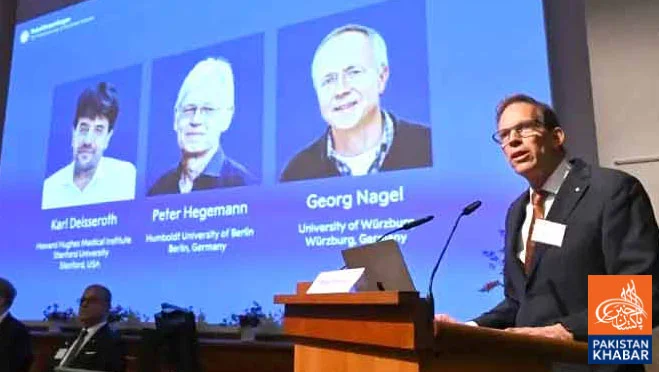
Washington (Web Desk) — American Karl Deisseroth and German scientists Peter Hegemann and Georg Nagel have won the 2026 Nobel Prize in Medicine for groundbreaking research that enables brain cells to be controlled using light.
The three scientists were honored for the development of optogenetics, a technique that uses light to activate or deactivate the activity of specific nerve cells in the brain.
According to the Nobel Committee, this technology has made it possible to control individual nerve cells in a living brain using light. This has helped scientists understand how the brain processes information and how different neurons communicate with one another.
The research is based on the discovery of light-sensitive proteins. Peter Hegemann and Georg Nagel made important advances in this field while studying responses to light in the 1990s, while Karl Deisseroth later applied the technology to nerve cells in mice and demonstrated a practical method for controlling brain activity with light.
Optogenetics is being used to study various brain disorders, including schizophrenia, Alzheimer’s disease, Parkinson’s disease, epilepsy and addiction. Researchers are also testing the technology for restoring vision and improving hearing-related devices. However, most potential treatments for humans are still at the experimental stage.