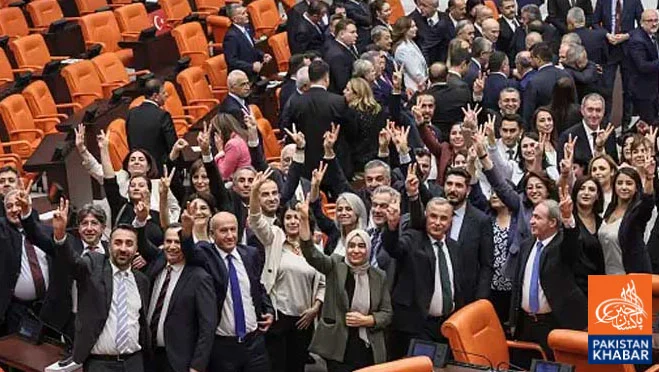
Ankara (Monitoring Desk): The Turkish Parliament has approved a law providing partial amnesty to some former fighters of the outlawed Kurdistan Workers’ Party (PKK) and suspending prison sentences.
According to Turkey’s state broadcaster, the law was introduced as part of the ongoing peace process between the government and the Kurdistan Workers’ Party. A total of 468 lawmakers voted in favour of the bill, while 88 opposed it and six lawmakers were absent. Members of the nationalist opposition Good Party were the strongest opponents of the bill.
Under the law, investigations and judicial proceedings related to most offences will be halted. However, murder cases committed during the Kurdistan Workers’ Party’s armed activities will not be covered by the exemption. Similarly, certain offences committed before 2005 that carry life imprisonment will remain outside the scope of the law.
As a result of the law, Kurdistan Workers’ Party leader Abdullah Ocalan, who is imprisoned, and the organization’s founders and senior members based in northern Iraq will not be eligible for the exemption.
The Kurdistan Workers’ Party waged an armed struggle against the Turkish state for more than 40 years. Following an appeal by Abdullah Ocalan, the organization announced its dissolution in 2025 and also held a symbolic ceremony as part of the process of laying down its arms.
Pro-government media welcomed the law, describing it as an important step towards the organization laying down its arms, while opposition-aligned media reacted cautiously, with some circles describing it as a concession to terrorism.
The Kurdistan Workers’ Party has been engaged in an armed struggle in Turkey since 1984. The left-wing organization was founded in the 1970s with the objective of establishing a separate state for Kurds in Turkey.
The Kurdish population is spread across southeastern Turkey, northeastern Syria, northern Iraq, northwestern Iran and western parts of Armenia. Estimates suggest that around 25 to 30 million Kurds live across these regions, making them the fourth-largest ethnic group in the Middle East after Arabs, Persians and Turks, although they do not have their own state.
Kurds account for approximately 15% to 20% of Turkey’s population. Following uprisings in the 1920s and 1930s, various restrictions were imposed on Kurdish identity, clothing and language in Turkey, and Kurds were referred to as “Mountain Turks” during that period.