

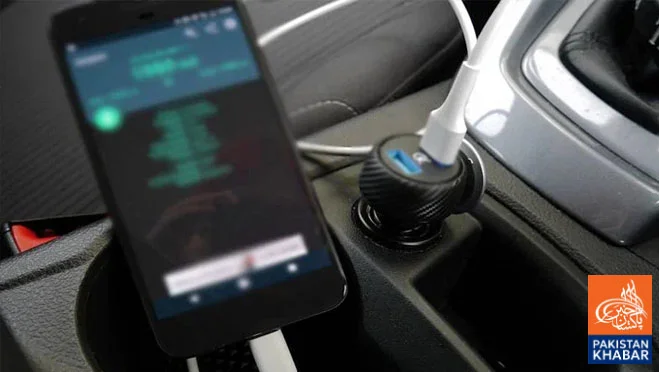
California (Web Desk) — Charging a mobile phone through a car’s USB port during travel is certainly convenient, but many users complain that their phone’s battery charges more slowly in the car compared with at home.
According to experts, charging speed mainly depends on voltage, amperage and wattage. The more power a charger provides, the faster the phone will charge, provided that the phone is also capable of using that amount of power.
Most modern phone chargers generally provide electricity between 5 and 9 volts, while household electrical systems have much higher voltage. However, a phone is not charged directly from household voltage; instead, the charger converts it into the required voltage and power.
According to experts, USB-A ports found in older vehicles often provide limited current, with some offering around 0.5 amps, which is insufficient for fast charging modern phones.
USB-C technology has helped improve charging speeds because it can provide more power than USB-A. However, if a vehicle’s USB-C port also provides limited wattage, the phone will not charge quickly.
Experts say the main reason for slow mobile charging through a car’s USB port is limited power supply. If the vehicle does not have a suitable high-speed USB-C port, using a car charger that provides higher power may be a better option.