

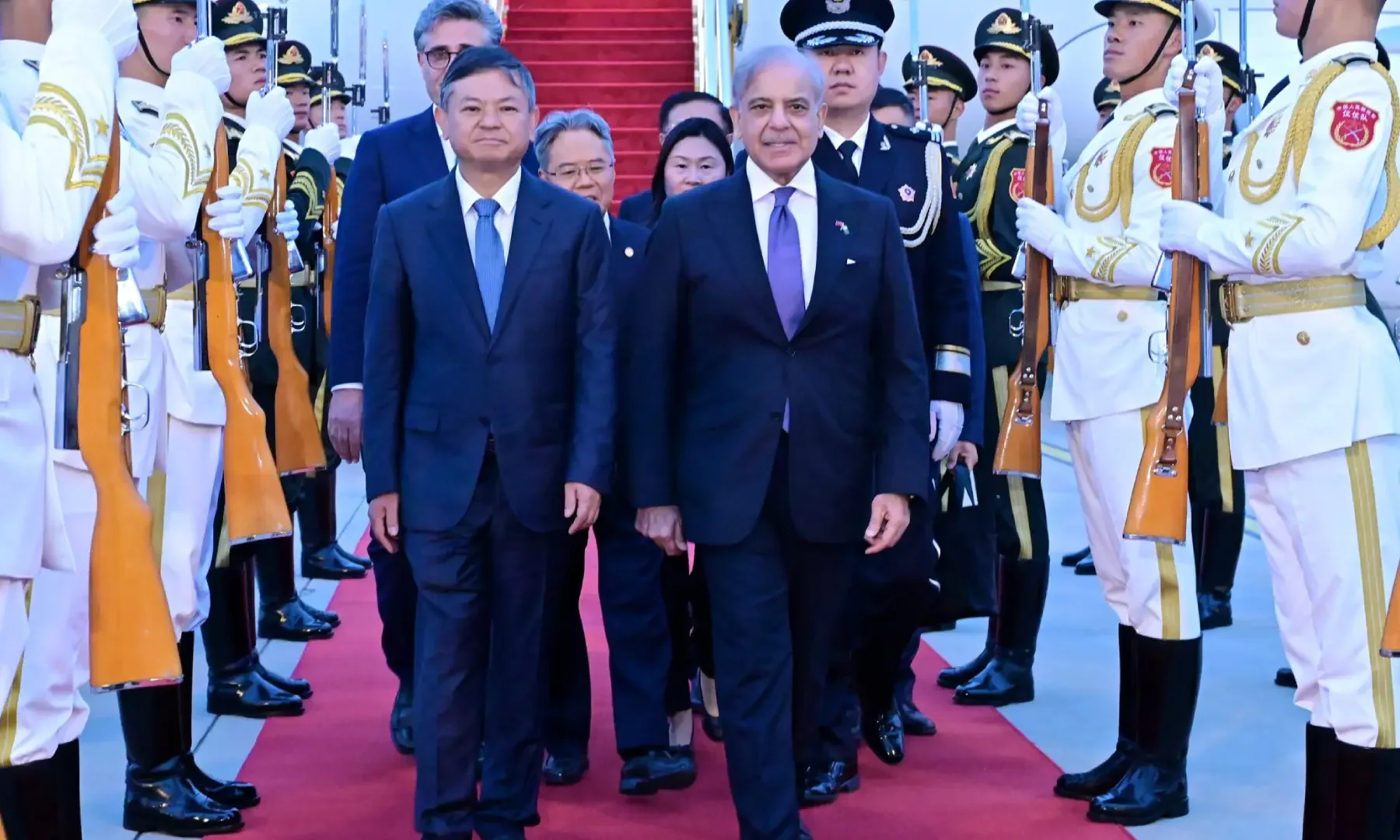
BEIJING: Prime Minister Shehbaz Sharif arrived in Beijing on Sunday as part of a four-day official visit to China, aiming to hold high-level meetings with Chinese President Xi Jinping and Premier Li Qiang.
Upon landing in the Chinese capital, the prime minister was warmly received by China's Minister for Environment and Ecology, Huang Runqiu. According to a statement from the Prime Minister’s Office (PMO), PM Sharif's engagements in Beijing will focus on further strengthening the Pakistan-China All-Weather Strategic Cooperative Partnership. Key discussions will center on advancing cooperation under CPEC Phase-II, with a special emphasis on trade, investment, industry, agriculture, science and technology, and people-to-people exchanges.
This high-profile visit coincides with the 75th anniversary of the establishment of diplomatic relations between Pakistan and China.
Hangzhou Visit and $1.22 Billion MoUs Prior to arriving in Beijing, PM Sharif landed in Hangzhou on Saturday, where he chaired the opening ceremony of the third Pakistan-China Business-to-Business (B2B) Investment Conference. The PMO confirmed that the prime minister witnessed the signing of several memoranda of understanding (MoUs) and cooperation agreements between Pakistani and Chinese companies, collectively worth $1.22 billion.
During his stay in Hangzhou, the prime minister engaged with provincial leadership and top Chinese enterprises, including StarCharge, CATL, and Xiuzheng Pharmaceutical. Discussions with CATL heavily focused on cooperation in advanced batteries, energy storage, and solar-linked solutions to bolster Pakistan’s clean energy transition. Additionally, PM Sharif visited Alibaba Headquarters, where he was welcomed by Executive Chairman Joe Tsai.
Pitching Industrial Relocation and Agricultural Growth Addressing the B2B Investment Conference, PM Sharif highlighted shifting global economic dynamics, noting that as China moves toward a very high level of industrialization and faces rising labor costs, there is a golden opportunity for industrial relocation to Pakistan.
"The industry where China is no longer competitive because of expensive labor can come to Pakistan, bring in plant and machinery, enter into joint ventures with Pakistani entrepreneurs, manufacture goods, and export to third countries," he stated. He termed this a "win-win model" that would prove to be a roaring success in sectors like textiles and leather. He also invited Chinese investors to explore the export zone in Karachi.
The prime minister drew attention to Pakistan's vast potential in mines, minerals, and agriculture. Noting that China imports around $100 billion worth of agricultural products annually, he stressed that Pakistan's current share is just a fraction. He set an ambitious target to increase Pakistan’s agricultural exports to China by $10 billion over the next five to seven years.
To facilitate this influx of investment, PM Sharif assured Chinese businesses of a seamless environment in Pakistan's Special Economic Zones, promising modern infrastructure, "red-carpet treatment," a one-window operation, and long-term land leases. He expressed deep satisfaction that 30% of the newly signed MoUs had already been converted into actionable agreements, running into billions of dollars.