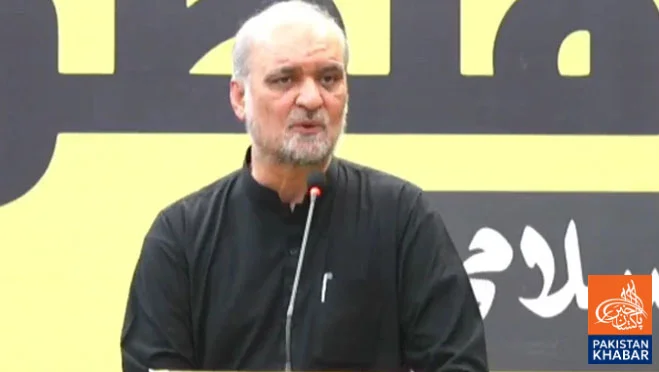
Karachi (Pakistan News): Jamaat-e-Islami Emir Hafiz Naeem ur Rehman has warned that if the government fails to take practical steps to abolish the petroleum levy, Jamaat-e-Islami will once again take to the streets in protest. He said that he had also demanded the abolition of the levy from Deputy Prime Minister Ishaq Dar.
Addressing a press conference at Idara Noor-e-Haq, Hafiz Naeem ur Rehman said that the government was collecting Rs. 150 billion every month through the petroleum levy, while the public was struggling under the burden of inflation. He said that Ishaq Dar had assured him that the relevant figures would be provided within a day or two.
The Jamaat-e-Islami Emir said that Ishaq Dar had argued that abolishing the levy would also make petrol cheaper for owners of large vehicles. In response, he proposed increasing the levy rate on owners of expensive vehicles, as they could afford to pay higher taxes, while providing relief in petrol prices to the middle and lower-income groups.
Hafiz Naeem ur Rehman said that Jamaat-e-Islami's struggle to abolish the petroleum levy would continue. He added that he had also met Prime Minister Shehbaz Sharif, who had sought time to provide further relief to the public. However, their fundamental demand was the complete abolition of the levy.
Referring to the US elections, he said that Donald Trump and pro-Israel groups had faced defeat in the elections held in the United States.
Speaking about the situation in Palestine, Hafiz Naeem ur Rehman said that following Operation Al-Aqsa Flood, Israel had destroyed the entire Gaza Strip to take revenge on the Palestinian people. He said that Palestinian resistance had demonstrated to the world what it meant to stand firmly against oppression.
He said that Pakistan's federal and provincial rulers were not true representatives of the public mandate, while the destruction of Karachi and corruption in Sindh had created severe difficulties for the people.
The Jamaat-e-Islami Emir further said that there was a need for a new global order, for which Muslims and resistance movements would have to unite. Referring to his visit to Türkiye, he said that discussions there focused on Islam's collective system rather than sectarian divisions, demonstrating that Islam is not merely a religion but a complete way of life.