

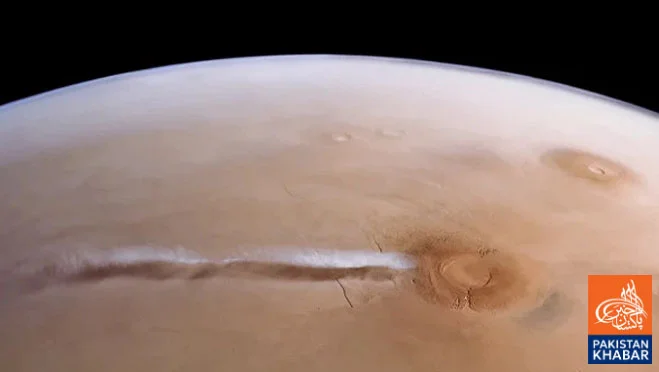
California (Web Desk): An unusual white cloud that appears daily during summer on Mars has captured the attention of scientists. A new study suggests that the cloud may form through the sudden freezing of material present in the atmosphere.
The research was published in the scientific journal Nature Geoscience and led by Dr. Jorge Hernández Bernal, affiliated with Sorbonne University. According to the researchers, this phenomenon could provide an important example of how clouds can form in an atmosphere through processes that differ from conventional explanations.
The cloud has been named the “Arsia Mons Elongated Cloud.” It is an extremely thin white cloud stretching approximately 1,800 kilometres and appears to the west of Arsia Mons, a Martian volcano that rises about 20 kilometres above the surface and is currently inactive.
Scientists have been observing this cloud for decades. It appears daily during the Martian summer, remains in the atmosphere for several hours before disappearing, and reappears in the same area the following morning. However, conventional atmospheric models have so far been unable to fully explain how it forms.
Experts explain that clouds generally form when moist air rises to higher altitudes and cools as it expands. This process allows water vapour in the air to form droplets. However, water molecules cannot easily join together to form droplets on their own, as extremely small droplets can evaporate again due to surface tension.
For this reason, dust and other tiny particles generally play an important role in cloud formation on Earth. Water vapour gathers around these particles and forms droplets. In contrast, under a process known as homogeneous nucleation, water molecules can directly form droplets without the assistance of such particles under certain conditions.
Scientists have so far regarded this process largely as a theoretical possibility studied mainly in laboratories. According to the researchers, if the cloud on Mars is indeed formed through this mechanism, it could represent a significant advance in understanding cloud formation in planetary atmospheres.
The findings could open new avenues for studying Mars’s weather systems and atmospheric conditions. However, further observations and research will be required to conclusively establish the actual mechanism behind the cloud’s formation.