

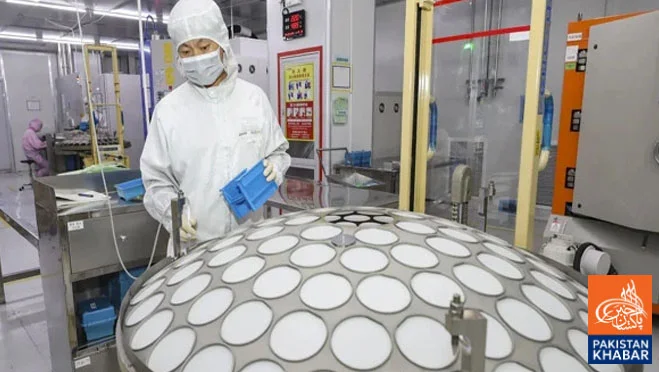
Beijing (Web Desk) — Chinese scientists have achieved a major breakthrough in semiconductor technology by developing an effective method to improve the durability of wurtzite ferroelectrics.
The breakthrough could help address a key challenge related to reliable memory performance in future high-performance computing and artificial intelligence systems.
The research was led by scientists from Xi’an Shiyou University, City University of Hong Kong and Fudan University.
The researchers successfully completed more than 10 billion data-writing cycles in wurtzite ferroelectrics. These are materials that can switch between two different electrical states, allowing data to be stored in them.
The durability achieved in the study is approximately 100 times higher than results previously reported for the same material.
Experts say this achievement could contribute to the development of next-generation memory technology and bring ferroelectric memory closer to practical use in future computing hardware.
If further experiments show that the technology can maintain the same performance, it could pave the way for developing more durable and reliable memory for future artificial intelligence and high-speed computing systems.