

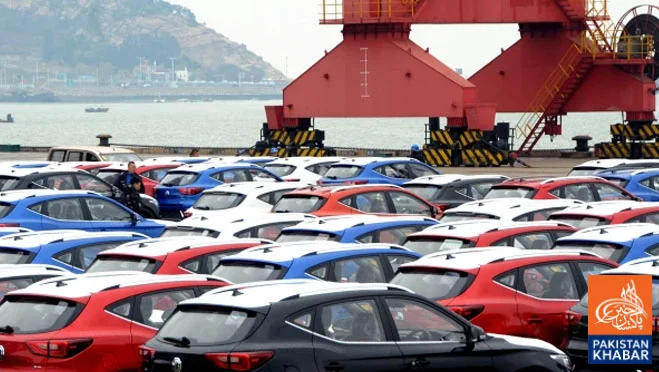
Islamabad (Commerce Desk) — China’s automobile industry has set a new record in vehicle exports this year, with Chinese vehicle exports exceeding the total number exported throughout the previous year by August.
Due to trade barriers in Western markets and excess production capacity in China, Chinese automakers are increasingly turning toward emerging markets, providing Pakistan with new opportunities in the industrial and energy sectors as well.
The expansion of Chinese companies in Pakistan has challenged the traditional dominance of Toyota, Honda and Suzuki, which had remained prominent in the country’s auto market for three decades.
Various Chinese brands have strengthened their presence, particularly in the SUV and crossover vehicle segments, while the arrival of BYD, Deepal and other companies is also rapidly expanding the electric vehicle market.
Pakistan’s New Energy Vehicle Policy 2025-30 is further supporting this transformation. Under the policy, targets have been set for new energy vehicles to account for 30 percent of new vehicle sales by 2030 and 50 percent by 2040.
The policy also includes measures such as establishing 3,000 public fast-charging stations by 2030, imposing a carbon levy on conventional fuel-powered vehicles and providing incentives for electric vehicles, as well as limiting charging tariffs to around Rs40 per kilowatt-hour.
The transition toward electric vehicles is important for Pakistan not only from an environmental perspective but could also help conserve energy and foreign exchange. Pakistan imports large quantities of petroleum products every year, spending valuable foreign exchange on them, while the country’s power sector is facing issues including excess generation capacity and low demand.
However, according to experts, the foreign exchange benefits from electric vehicle imports and local assembly could remain limited if battery packs, electrical systems, motors and other key components are imported from abroad.
The key challenge for Pakistan is to convert Chinese technology and investment into local industrial capacity rather than limiting it to vehicle assembly.
For this purpose, local production can be promoted in areas such as battery pack assembly, wiring harnesses, castings, plastics, vehicle interiors, charging equipment and thermal management. While producing complex technologies such as battery cells and advanced semiconductors in Pakistan immediately may be difficult, local investment is possible in parts of the value chain where the country can develop competitive capabilities.
Charging infrastructure will also play a fundamental role in promoting electric vehicles. Competition between electric and hybrid vehicles is also increasing in Pakistan, as Japanese companies seek to maintain their position in the market through their hybrid technology.