

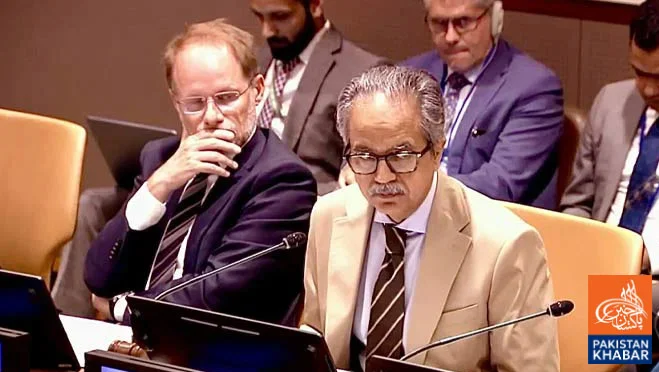
Washington (Pakistan News): Pakistan has made it clear to the United Nations Security Council that it will take action in self-defense, if necessary, against terrorist threats emanating from Afghanistan, while fully complying with international law.
Addressing a Security Council meeting, Pakistan’s Permanent Representative to the United Nations, Asim Iftikhar Ahmad, said Pakistan could not remain silent over this wave of terrorism and would exercise its right to defend itself against those attempting to harm its citizens and national security.
He said that over the past three years, more than 4,700 Pakistanis have lost their lives due to terrorism originating from Afghanistan, while Kabul has failed to take effective and verifiable measures against terrorist organizations present on Afghan soil.
According to Asim Iftikhar Ahmad, Afghanistan has once again become a safe haven for terrorist groups, including the Tehreek-e-Taliban Pakistan, the banned Baloch Liberation Army and its Majeed Brigade, ISIS-Khorasan, the East Turkestan Islamic Movement and their allies.
The Pakistani envoy said external elements were also complicating the situation and using groups supported by them in Afghanistan against Pakistan and other neighboring countries.
Referring to a recent report by UN Secretary-General Antonio Guterres, he said terrorist groups remain present in Afghanistan, while restrictions on women and girls, keeping them away from government processes, economic difficulties, limited access to basic services, and large-scale returns and migration pose threats to the country’s long-term stability.
According to the report, armed groups opposed to the Taliban are also active and claimed responsibility for 88 attacks in 21 Afghan provinces from May 1 to the end of July.
Asim Iftikhar Ahmad said the institutional deprivation of women and girls of their rights and the authoritarian nature of the Taliban’s political system had also emerged as major concerns in the UN report, while such policies were affecting Afghan society and creating obstacles to Afghanistan’s reintegration into the international system.
He said Pakistan had played its role in Afghanistan’s stability through engagement, humanitarian assistance and regional cooperation. Despite concerns over some Taliban policies, Islamabad fulfilled its international responsibilities and continued the unhindered delivery of humanitarian assistance to Afghanistan.
According to him, at least 687 trucks loaded with relief supplies reached Afghanistan through Pakistan during the reporting period.
The Pakistani envoy said that the hopes the international community had placed in Afghanistan five years ago had not been fulfilled and had gradually turned into disappointment. The severity of the challenges facing Afghanistan is clear, and behind the seemingly stable situation presented by the Taliban are risks that could affect the country’s stability in the short and long term.
Asim Iftikhar Ahmad said terrorism was central to Afghanistan’s problems, with one major reason being deep links between the Taliban and terrorist groups, while the Afghan Taliban had failed to take effective action against these groups.
He also warned of the risks arising from weapons left behind by international forces in Afghanistan and the smuggling of illegal arms.